
Warehouse Management System (WMS)
Gain complete visibility and control over inventory, warehouse operations, and order fulfillment processes.
ICAS Technology, a Singapore-based intralogistics system integrator, provides warehouse management systems that give real-time visibility of inventory, manage warehouse activities, and support accurate order fulfillment through structured workflows and operational control — from inbound goods and storage to picking and outbound shipments.
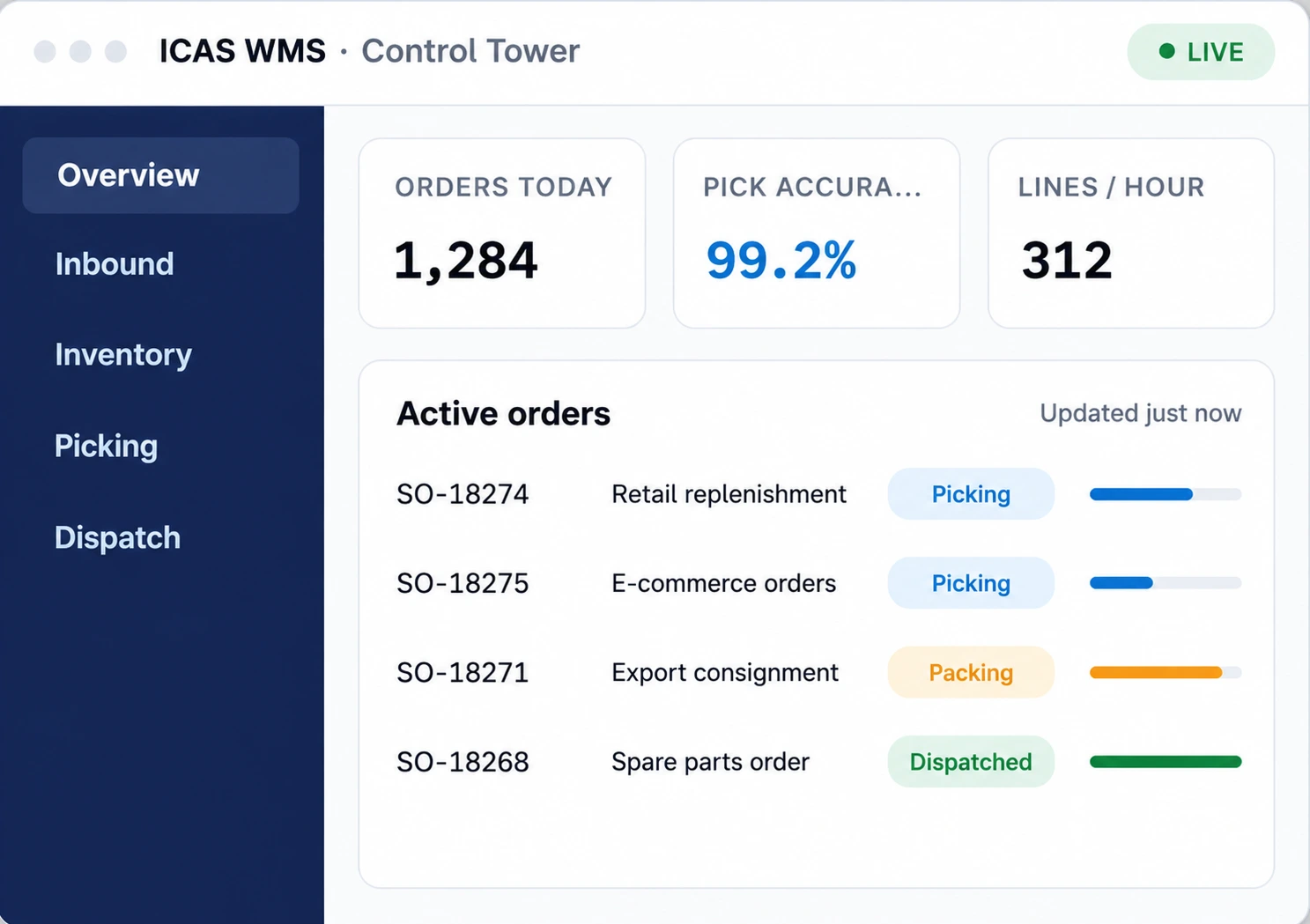
Illustrative interface. Sample data, not actual performance.
What a Warehouse Management System Delivers
Inventory visibility
Maintain real-time visibility of inventory across locations and processes.
Inventory accuracy
Reduce inventory discrepancies and fulfillment errors through controlled workflows.
Operational efficiency
Optimize warehouse activities and resource utilization.
Traceability
Track inventory movement throughout the warehouse lifecycle.
How a WMS Controls Goods from Receipt to Shipping
Goods receipt is where incoming stock is recorded. Putaway moves it to a storage location, and storage keeps a live record of what is held where. Picking collects items for each order, packing prepares them for dispatch, and shipping completes the cycle. A WMS tracks stock through all six stages so inventory records stay accurate.
Warehouse Operations a WMS Supports in Singapore
Where a WMS supports warehouse operations
WMS Integration with ERP, Barcode Systems and Automation
Integrates with ERP systems, warehouse automation equipment, barcode technologies, and Warehouse Control Systems (WCS) to support a connected warehouse ecosystem. The WMS manages inventory, orders and workflows; the WCS coordinates the automation equipment that carries them out.
A WMS typically exchanges orders, item data and stock movements with your ERP, confirms picks and putaway through barcode scanning, and passes work to a Warehouse Control System when automation equipment is involved. The interfaces depend on your existing systems and are scoped with our specialists.
How to Choose Warehouse Management Software in Singapore
The right warehouse management software depends on how your warehouse actually runs. Work through these points with your team before comparing systems.
- Order and stock profile.
- Storage and picking methods, including racking, mobile racking, vertical lift modules, carousels and shuttles.
- ERP interface: which system owns item, order and stock data, and how errors are handled.
- Scanning and shop-floor devices.
- Automation plans, and how the WMS hands tasks to a WCS.
- Rollout and support: data migration, training, testing and aftercare.
ICAS Technology can help evaluate these points for your operation.
Warehouse Management System FAQs
What the Warehouse Management System covers, and how it fits your ERP, barcode systems, and fulfillment operation.
What warehouse activities does a WMS cover?
Goods receipt, putaway, storage, picking, packing, and shipping — full lifecycle inventory tracking and control.
Does WMS integrate with our ERP and barcode systems?
Yes — it connects with ERP systems, barcode technologies, warehouse automation equipment, and WCS for a unified ecosystem. The interfaces depend on your existing systems and are scoped with our specialists.
Is WMS suitable for e-commerce fulfillment?
Yes — it's built for distribution centers, retail distribution, and e-commerce fulfillment operations alike.
What is a warehouse management system?
A warehouse management system (WMS) is software that records and controls the movement of inventory inside a warehouse, from goods receipt and putaway to picking, packing and shipping. It gives a live view of stock and structures the workflows that fulfill each order.
What is the difference between a WMS and ERP inventory management?
An ERP records inventory and orders at company level. A WMS manages what happens on the warehouse floor: where stock is located and how it moves through receiving, putaway, picking, packing and shipping.
How do I choose a WMS for a warehouse in Singapore?
Start with how your warehouse works today: your order profile, storage methods and any automation equipment. Then check that the WMS connects with your ERP and barcode systems and can grow with your operation. ICAS Technology is a Singapore-based system integrator that connects warehouse management software with ERP, barcode systems and compatible warehouse automation equipment. Our specialists can help evaluate your requirements.
Do we need a WCS if we already have a WMS?
A WMS alone may be sufficient when stock is handled manually or through handheld devices. When conveyors, sorters, shuttles or AMRs are involved, a WCS can coordinate equipment while the WMS manages inventory and orders.
What does a WMS integration with ERP usually involve?
Agreeing which system owns which data, defining what information is exchanged and how often, and testing exceptions before go-live. The specific interfaces depend on the existing systems.
What should we prepare before a WMS project?
Item and location data, current process descriptions, ERP and barcode system details, and a list of any automation equipment.
Let's Design a Warehouse Management Strategy
That Works For Your Operation
Every warehouse operates differently. Our specialists can help evaluate your requirements and recommend the right solution for your workflows and growth plans
Talk to a Solutions Specialist